Achieving Operational Excellence: The Role of IT Project Management
How can I be more productive? It’s a million dollars question. At a first glance it seems like an easy question to answe...
- OCTOBER 3, 2024
- IT & Software


APRIL 6, 2026

This website
uses cookies
Factories used to run on machines. Now, they run on data. Across Europe, industrial environments are being reshaped by IoT: the Internet of Things tailored for manufacturing.
This interconnected network of devices, sensors, vehicles, and systems bridges the physical and digital worlds, embedding intelligence into production lines that perceive, analyse, and respond in real time. For companies operating in complex engineering environments, IoT adoption is imperative.
Industry 4.0 represents a fundamental shift in how production works. It’s the fourth industrial revolution: the integration of digital technologies like IoT, AI, robotics and big data into manufacturing processes.
By connecting machines, systems and processes, IoT allows connected devices to communicate continuously, creating a digital layer on top of physical operations. This is what enables smart manufacturing to move from reactive to predictive.
Think about it: why settle for machines that merely obey when you can have ones that anticipate? By embedding smart sensors in factory machines, they can monitor temperature, vibration, pressure, and energy use. The data reveals patterns humans miss, reducing waste, boosting safety, and driving greener operations. Isn’t it time your factory got this smart?
In smart manufacturing environments, this visibility changes everything:
This approach enhances quality control, workplace safety, and productivity while aligning with Europe's sustainability goals in Industry 4.0.
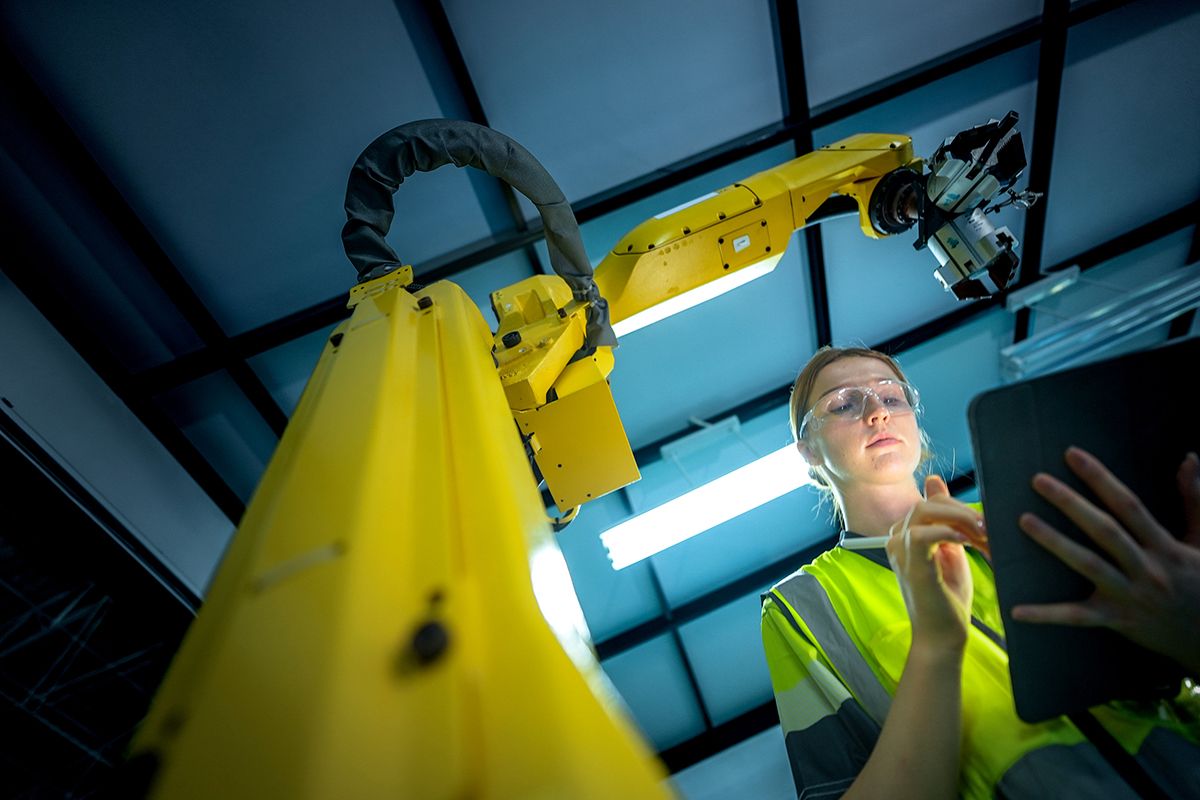
What’s a connected device? Think of it as any factory gear – from a humble temperature sensor on a motor to a full-blown robotic arm – plugged into the IoT network. These everyday workhorses now have digital eyes and ears: they measure, record, and beam data live to a central brain.
The magic happens where no one’s looking. Connected devices hum quietly in the background, gathering data and whispering insights without missing a beat in your workflow. But don’t be fooled by the silence: their impact is profound.
A single production line setup can include hundreds of sensors, each contributing to a broader understanding of performance. When integrated into a unified IoT architecture, these devices create a system that learns and improves over time. This is where digitalization becomes practical. Instead of isolated machines, companies operate interconnected systems that adapt continuously.
Data alone does nothing. The real value of IoT lies in what companies do with it. When combined with analytics and automation, IoT enables faster and more accurate decision-making.
A strong example comes from European energy infrastructure. Grid operators are using IoT-enabled sensors to monitor environmental conditions in real time, improving capacity planning and integrating renewable energy sources more effectively.
The same principle applies to industrial environments. Data collected from connected devices feeds into systems that support predictive maintenance, automated quality control and smarter resource allocation. Smart manufacturing doesn’t necessarily evolve through more data, but through better decisions.
If IoT is so powerful, why isn’t everyone doing it successfully? The truth is that implementation is complex. Many organisations face similar challenges that often slow progress:
Without a thoughtful approach, even the best IoT initiatives can fragment and underperform. The good news? These challenges are solvable – with the right expertise.
There is no off-the-shelf solution for a smart factory. Successful IoT implementation requires a tailored approach that aligns technology with business objectives. It starts with understanding operational challenges and identifying where IoT can create measurable impact.
At Prime Engineering, we support this transformation through a structured approach:
Efficiency used to mean cutting costs. Today, it’s about adaptability. Companies embracing Industrial IoT and smart manufacturing respond faster, optimise continuously, and scale effortlessly: a decisive edge in Industry 4.0. The European Commission underscores this, noting digital technologies as pivotal for boosting industrial competitiveness and sustainability across the EU.
IoT isn’t merely a technology upgrade; it’s a fundamental shift in how operations think, act, and evolve. At Prime Engineering Italia, we design and implement IoT solutions that power smart factories, connect devices seamlessly, and accelerate digitalisation in complex environments.
Ready to start your industrial IoT transformation? Request a tailored quote today and start building your competitive future.
How can I be more productive? It’s a million dollars question. At a first glance it seems like an easy question to answe...
The manufacturing world is evolving at record speed. Machines, data and human expertise are now deeply connected, shapin...